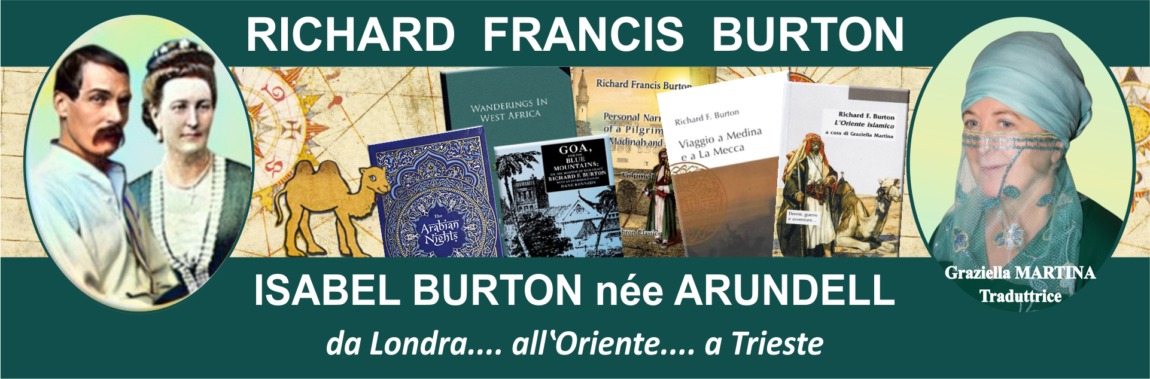

BRIEF BIOGRAPHY OF RICHARD F. BURTON
1821 Born in Torquay, in Devon
1826-39 Travels with his family in Europe, especially in France and in Italy
1840 Enrolls at Trinity College, Oxford. Is expelled two years later
1842-1849 Serves in the army in India
1853 Makes a journey to Medina and to Mecca
1858 With Speke explores the lakes of central Africa in search of the sources of the Nile
BURUNDI - NYANZA LAC
These plaques are located near the point at which, in April 1858, Richard Francis Burton and John Speke landed when they were searching for the sources of the Nile.
1860 Makes a journey to the Mormons in Salt Lake City
1861 Marries Isabel Arundell
1865 Is appointed consul in Santos, in Brazil, after having been in Fernando Po, in Equatorial Guinea
1869 Is appointed consul in Damascus, in Syria, but is recalled two years later
1873 Is appointed consul in Trieste, where he remains for 18 years and where he dies in 1890.
Richard and Isabel Burton spend the first six months of their stay in Trieste at the Hotel de Ville. Then, they move to the fourth floor of this building, which is located on the station square. A curiosity: next to the entrance, there is today a Kebab Ali Baba. At the beginning, they occupy only six rooms, then gradually they expand over the whole floor. The view of the port and inland is wonderful; the rooms are crammed with bronze trays, gilded plates, Persian enamels, English porcelains, mirrors, photos, personal souvenirs, medals, diplomas... There is Isabel's piano and there are thousands of books, with Richard's in the place of honor. Their days are full. He writes books — beginning with the one on Iceland — studies Russian and Greek, follows courses in chemistry and botany. She practices singing and carries on with her book on Syria. In the afternoon, they go swimming at the baths beside the port. They dive into the space delimited by pontoons and nets, placed there "to keep the sharks away", as Isabel says, from the roof of the cabins. Alternatively, both practice fencing. From 4 to 6 p.m. he goes to the Consulate. In the evening they go to dine at the restaurant of the Hotel de Ville.
When the heat becomes oppressive, Richard and Isabel go to Opicina, to the Daneu inn, today unfortunately closed and in ruins. They take long walks in the surrounding pine woods and in the chestnut woods.
In 1877, the hotel is run by a very young couple. She is only 16 years old and, when her baby falls ill, does not really know what to do. Isabel takes it upon herself to "take charge of" the newborn. For three weeks she cares for him, feeds him, holds him in her arms, dresses him like a little English prince....
A plaque affixed in 1972 — on the occasion of the centenary of Burton's arrival in Trieste — on the outer wall of what, in the meantime, had been renamed Hotel Obelisco, was unfortunately taken away.
In 1883, the 120 steps necessary to reach the lodging in Piazza della Libertà have become too heavy. There is a villa, at the bottom of the climb to the promontory, that appeals to both of them. It is Palazzo Gossleth, subsequently called Villa Economo, built a century earlier by a rich Englishman. The building has a Palladian facade, an enormous entrance and a large staircase of polished marble. Nor is there lacking a fine garden with centuries-old trees. The Burton couple move there in the spring of 1883 and Richard reserves for himself a separate apartment, formed by a large room used as a study (perhaps on the second floor, on the right corner of the facade) with several work tables, a bedroom and a dressing room. In winter, while he works, he wears a coat with fur-trimmed edges while in bed he covers himself with a buffalo skin. Villa Gossleth is the last residence of the writer, who dies there on 20 October 1890.
The fireplace that can be seen in the photos below was located in the salon of Villa Gossleth, today Villa Economo, at the time when Richard and Isabel lived there. In the 1960s, the villa was sold to the construction firm Antonini & Fragiacomo. This firm made many apartments out of it and built next to it two twin houses. It was then that, at the request of the first owner of the building, the fireplace was removed from the salon of the villa and transferred to the apartment of one of the lateral wings of the building, where it is still today.
Trieste has dedicated a street to Richard Francis Burton explorer and archaeologist. No taxi driver knows where it is, but if you look for it carefully on the map (not the one for tourists) you will find it. It is a small, short street, almost in the middle of the woods, or rather, the grove. Perhaps the figure is not illustrious enough to attribute to him a more important street as a sign of homage, or, perhaps, his life has always been a little foreign to that of the city.
In an episode of Superquark dedicated to David Livingstone and the explorers of Africa, in particular to those who went in search of the mysterious sources of the Nile, they were talking about my beloved Richard Francis Burton.
Piero Angela did well to underline the enormous difference in travel conditions between us, today's visitors to the continent, and the explorers of that time. We today leave with antibiotics behind us and after having done anti-malarial prophylaxis and injections against yellow fever; we cross the country aboard fast jeeps; in the evening we wash the dust from our bodies under the hot shower of the hotel; we go down to the bar to drink an iced beverage, we move to the restaurant to eat a good dinner and finally we go to sleep on a soft mattress. And, before falling asleep, we perhaps make a telephone call home.
Very different was the journey undertaken by Burton and Speke: The only paths then existing were those, very narrow, created by animals, by hunters or by slave merchants in the midst of thorny bushes and low tangled branches. If it rained, the ground became a swamp in which one sank. Desert stretches alternated with those with grass high up above the head or with mountainous ones, where the tents could not be pitched. One was exposed to the bite of the tsetse fly, to that of snakes or poisonous spiders. There was the risk of being attacked by the indigenous people, one proceeded without maps, without guides who knew the way, with superstitious and unreliable porters. An almost superhuman enterprise...
The Opicina Tram: A Symbol of Trieste
Yesterday 16 August, 7 years have passed since the famous Opicina tram stopped rumbling along the steep Trieste slopes. Seven long years during which the heart of the city has felt the absence of this historic and technological symbol. The tramway, operational since 1902, is not only a means of transport, but a living testimony of the history of Trieste. It offers a panoramic journey from the city centre up to the high Karst, where one can enjoy a breathtaking view of Trieste and the Adriatic Sea.
The experience of getting on the tram and feeling it struggle against the gradient, helped by its funicular mechanics, is something that every person from Trieste, and not only, should experience. And it is precisely the steep climb that makes this tram unique: with a gradient that reaches 26%, it is a true marvel of technology.
The Song and the Myth
"El tram de Opcina" resounds in the ears of anyone who knows Trieste. This cheerful melody tells of a somewhat less happy episode, when a tram motor car had a mishap back in distant 1902. And as the song says, the tram seems to have been "born unlucky", especially in these last years.
But Trieste is resilient and its spirit indomitable. Despite the difficulties, the people of Trieste await confidently the day when the classic rumble of the tram will echo again.
And when that day arrives, Trieste will celebrate the rebirth of a part of its heart. Until then, let us continue to hope, sing and tell the stories of our beloved Opicina tram.